

How to Buy Food Grade Ethanol in Washington D.C.

Quick Answer: Buying Food-Grade Ethanol in Washington, D.C. for Business Use
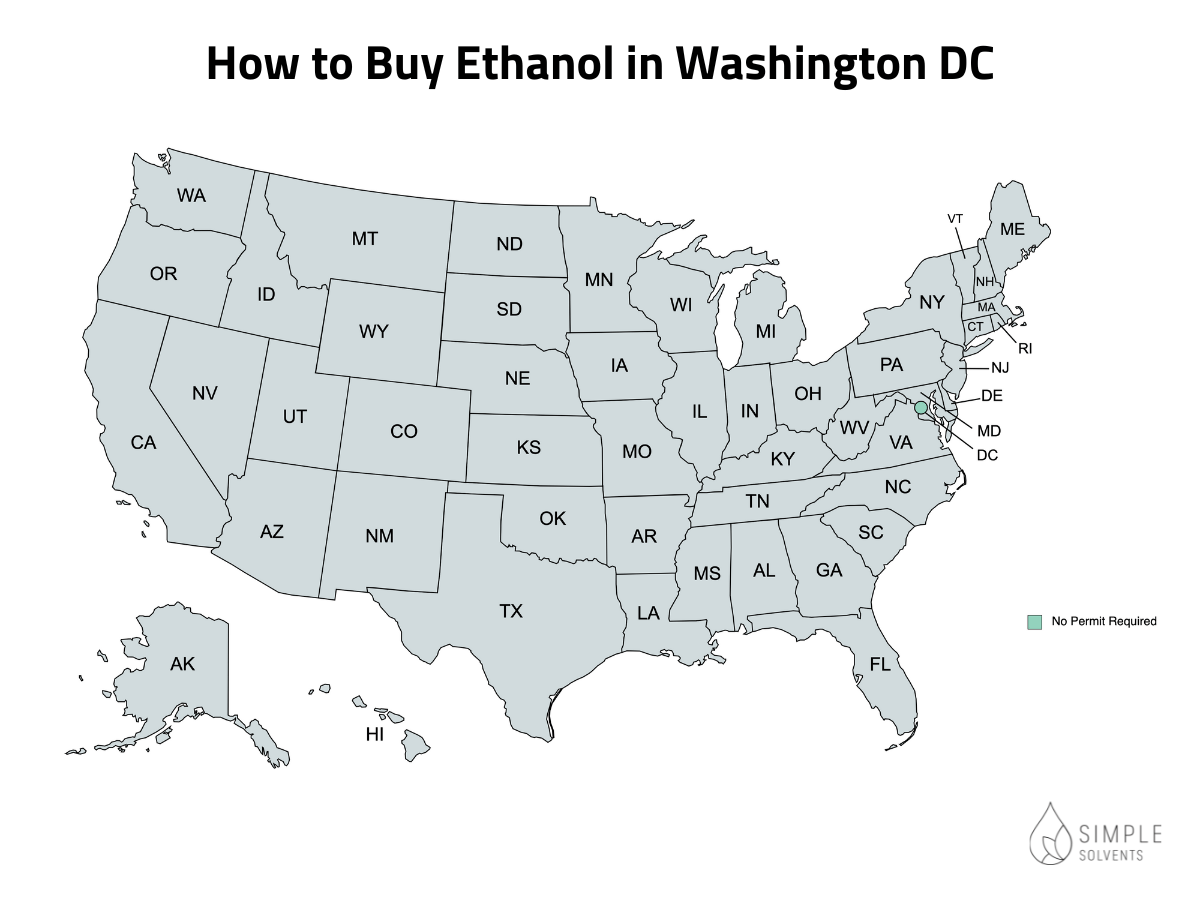
Short answer: yes. For industrial and business-to-business (B2B) use, Washington, D.C. does not require a special state permit to buy 190/200-proof food-grade (non-denatured) ethanol for extraction, manufacturing, or other industrial use — D.C. Code §25-103(b)(1)-(4) covers this. Federal TTB rules for the seller still apply regardless of state. This is general information, not legal advice.
You can also check any state at a glance using our interactive tool: Ethanol Shipping Rules by State.
Who This Guide Is For
Simple Solvents sells exclusively to businesses — extraction labs, manufacturers, cosmetics and pharmaceutical companies, and other industrial buyers — for industrial, scientific, and manufacturing use. We do not sell to individual consumers and we do not sell for beverage use. This guide covers three product types: non-denatured (food-grade) 190/200-proof ethanol, specially denatured alcohol (SDA), and completely denatured alcohol (CDA).
Washington, D.C.’s Rules for Industrial & Business Buyers
D.C. Code §25-103(b)(1)-(4). This carve-out applies without needing a separate state permit for the industrial use described above. Covers denatured alcohol, medicinal/pharmaceutical/toilet preparations, flavoring/food products, and scientific/chemical/mechanical/industrial products; no proof/quantity condition in §25-103.
Denatured Alcohol (SDA & CDA)
Specially Denatured Alcohol (SDA): Federal TTB Part 20 permit applies to SDA users.
Completely Denatured Alcohol (CDA): §25-103 expressly exempts federally produced/used denatured alcohol and qualifying nonbeverage products from the D.C. title.
The Federal Baseline (Applies in Every State)
Regardless of state, sellers of tax-paid, non-denatured (food-grade) alcohol must be registered as TTB liquor dealers under 27 CFR Part 31 (Form 5630.5d) and generally must sell in bulk containers of more than 1 U.S. gallon, with required recordkeeping. Buyers of ordinary tax-paid, non-denatured alcohol typically need no separate federal permit. Buyers of specially denatured alcohol (SDA) need a federal TTB Industrial Alcohol User Permit (27 CFR Part 20, Form 5150.33). Tax-free (non-tax-paid) alcohol follows a separate, narrower federal path (27 CFR Part 22) that most industrial buyers of tax-paid product do not need.
Ordering Food-Grade Ethanol from Simple Solvents
- Confirm your business’s specific permit needs (if any) using this guide and, where noted, your state agency.
- Visit SimpleSolvents.com and choose the product and grade (non-denatured, SDA, or CDA) that fits your process.
- Complete checkout with your business shipping and billing information.
- Provide any required permit documentation if your state requires it for your order.
- Track your shipment using the tracking information we provide after your order ships.
Frequently Asked Questions
Do I need a permit to buy food-grade ethanol in Washington, D.C. for business use?
No special state permit is required for qualifying industrial/business use under D.C. Code §25-103(b)(1)-(4), though federal seller-registration rules always apply.
Does this apply to denatured alcohol (SDA/CDA) too?
Federal TTB Part 20 permit applies to SDA users. §25-103 expressly exempts federally produced/used denatured alcohol and qualifying nonbeverage products from the D.C. title.
Is this guide for personal or beverage use?
No. Simple Solvents sells only to businesses for industrial, scientific, and manufacturing use — never to individual consumers and never for beverage use.
Bonus: Beverage Alcohol Rules
This guide only covers industrial and business use of ethanol. Washington, D.C. has separate rules for beverage alcohol that do not apply to Simple Solvents’ business customers: D.C. separately regulates beverage imports; common-carrier delivery to a nonlicensee is limited to one case per person/location per month absent specified licensing.
This information is provided for general guidance only and is not legal advice. Regulations change. Please confirm your specific requirements with the relevant state agency and your own counsel before placing an order. Research confidence: High.