

d-Limonene
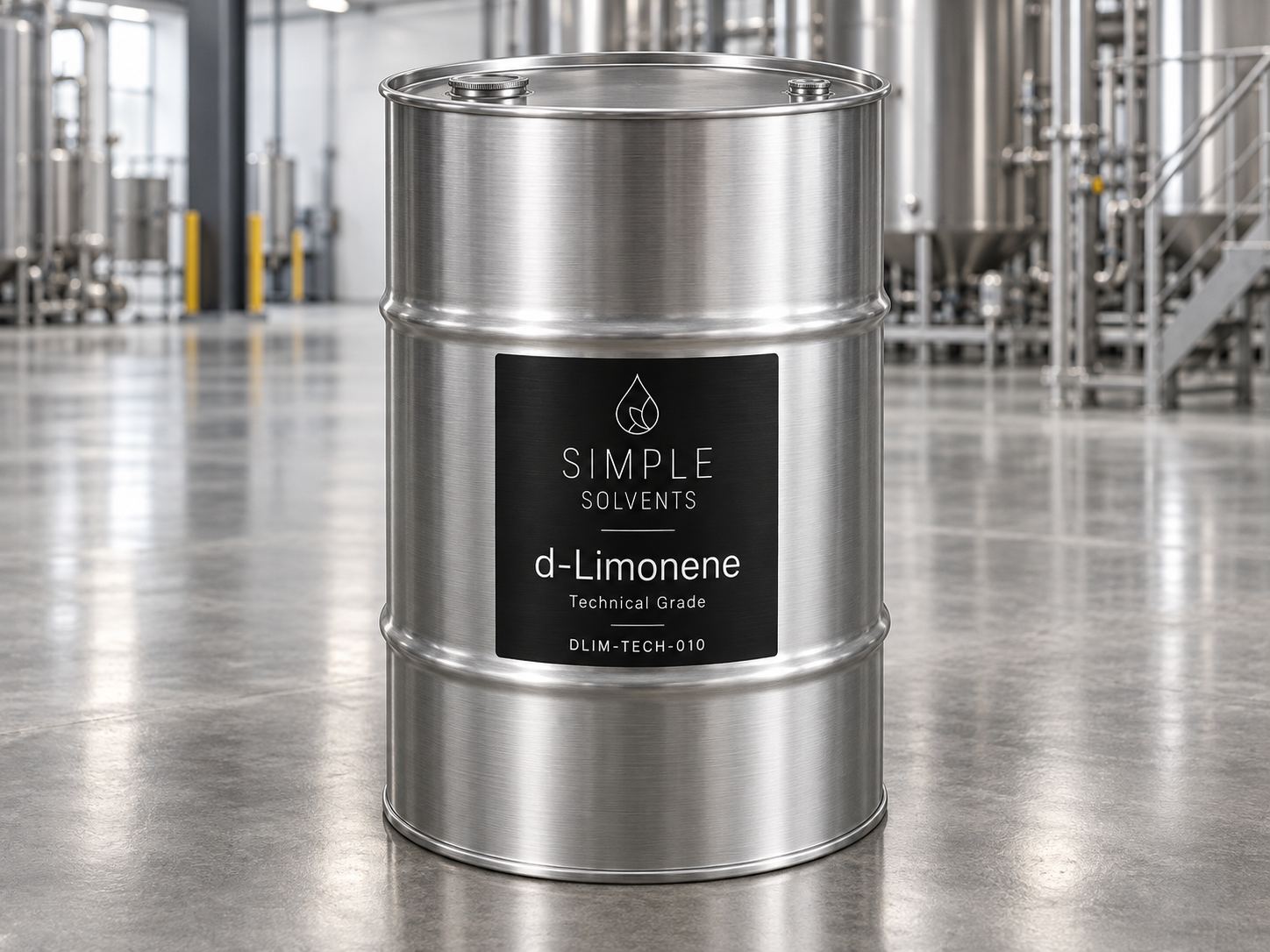
d-Limonene is a natural citrus-derived terpene solvent prized for degreasing, cleaning, and fragrance use. Available in Food Grade and Technical Grade, shipped by Drum, Tote, Tanker, or Railcar.
Real Quotes From Real People โ A Rep Calls You Back Fast.
Shopping for something listed here? Add it to your cart to request a quote.
Lab Tested
Secure Payments
Quality Guarantee
Fast Delivery
d-Limonene – Citrus Terpene Solvent
d-Limonene (CAS 5989-27-5) is a naturally derived terpene extracted from citrus rinds (primarily orange peel), valued as a renewable, biodegradable alternative to petroleum-based solvents. It has a clean, strong citrus aroma and powerful solvency for oils, greases, resins, and adhesives.
Common d-Limonene Uses
- Industrial & Consumer Cleaning: Cuts grease, oil, and adhesive residue in degreasers, hand cleaners, and citrus-based cleaning products.
- Fragrance & Flavor: Citrus scent/flavor component in candles, perfumes, personal care products, and food/beverage formulations (Food Grade).
- Botanical Extraction: Used as a co-solvent or terpene additive in extraction and formulation work.
- Rubber, Resin & Adhesive Processing: Dissolves rubber, resins, and adhesives for reclaiming and equipment cleanup.
- Paint & Coatings: Low-odor solvent alternative for equipment cleanup.
Available in Food Grade (min. 94% assay, suitable for food/flavor and USP-adjacent applications) and Technical Grade (min. 95% assay, for industrial cleaning and formulation use).
Industrial alcohol user / seller permit is NOT required to purchase d-Limonene.
What is d-Limonene used for?
d-Limonene is a citrus-derived terpene solvent used in cleaning and degreasing products, fragrance and flavor formulations, botanical extraction, and as a natural alternative to petroleum-based solvents.
What is the difference between Food Grade and Technical Grade d-Limonene?
Food Grade d-Limonene meets purity standards for use in food, beverage, and flavor applications, while Technical Grade is intended for industrial uses such as cleaning, degreasing, and manufacturing where food-contact purity is not required.
What sizes does Simple Solvents ship d-Limonene in?
d-Limonene is available in 55 gallon drums, 270 gallon totes, tanker truckloads, and railcar quantities to support both smaller wholesale orders and large industrial volumes.
Can I get a Certificate of Analysis (COA) for d-Limonene?
Yes, a Certificate of Analysis is available for each batch of d-Limonene sold by Simple Solvents to confirm purity and quality specifications.
Is d-Limonene flammable or hazardous to ship?
d-Limonene is a combustible liquid and is classified as a hazardous material for shipping purposes, so drums and totes must be transported upright and secured, not on their side.
Why can d-Limonene be shipped in a poly tote when many other solvents cannot?
d-Limonene is chemically compatible with polyethylene tote packaging, unlike many industrial solvents that can degrade poly totes over time, which is why it is one of the few products Simple Solvents offers in tote quantities.
| Weight | N/A |
|---|---|
| Dimensions | N/A |
| GradeOur comprehensive range of chemical and food ingredients comes in various grades, ensuring that you have the right product for every application. Each grade reflects a level of purity and suitability for specific uses, from laboratory experiments to food production and personal care products. USP Grade (United States Pharmacopeia): This pharmaceutical-grade standard ensures ingredients meet the strictest quality, purity, and safety criteria, making them ideal for medical and healthcare applications. Food Grade: Certified safe for use in food production, our Food Grade ingredients comply with regulatory standards for human consumption. FCC Grade (Food Chemicals Codex): Ingredients classified under FCC Grade meet the safety, identity, and purity requirements for use in food, beverages, and dietary supplements. USP / FCC Grade: Dual-compliant ingredients that adhere to both USP and FCC standards, ensuring the highest quality for both pharmaceutical and food-related applications. Technical Grade: Suitable for industrial applications, Technical Grade products are not intended for consumption but are perfect for manufacturing, cleaning, and processing needs. ACS Grade (American Chemical Society): Trusted for laboratory and research purposes, ACS Grade chemicals meet high purity standards, making them ideal for precise and controlled scientific experiments. Lab Grade: These versatile chemicals are suitable for general laboratory work where high levels of purity are not mandatory but still necessary for accuracy. NF Grade (National Formulary): Ingredients classified as NF Grade meet the rigorous standards of the National Formulary, ensuring they are suitable for pharmaceutical applications, particularly in the formulation of excipients. Whether you\'re manufacturing food, conducting laboratory experiments, or producing pharmaceuticals, our diverse selection of grades ensures youโll find the exact quality and compliance you need for any project. | Food Grade, Technical Grade |
| SizeWe offer a wide range of packaging sizes to meet your specific requirements, whether you need small quantities for testing or large volumes for manufacturing. Our flexible packaging options ensure you can find the right size for your operational scale, from small batches to full-scale production. 1 Gallon: Ideal for smaller projects, lab work, or testing new formulations, this size offers convenience and precision without excess waste. 5 Gallon: Perfect for medium-scale operations, this size is commonly used in research labs, small production runs, and craft industries. 55 Gallon: A go-to option for larger production needs, our 55-gallon drums provide a practical solution for manufacturers and processors looking to scale up while maintaining efficiency. 270 Gallon: For high-volume applications, this large-capacity option ensures cost-effectiveness and reduced downtime for refilling, making it ideal for large-scale industrial, food, and beverage production. Bulk: For operations that require the highest volumes, we offer bulk packaging solutions tailored to your needs. Whether you need tankers or custom bulk deliveries, we can provide scalable options to support your growing demands. Each packaging size is designed with durability and ease of handling in mind, ensuring safe transport and storage. Choose the size that fits your needs and enjoy the convenience of high-quality products delivered in the quantities that best suit your business. | 270 Gallon Tote, 55 Gallon Drum, Railcar, Tanker |
Common Names
d-Limonene, Citrus Terpene, Orange Terpene, Dipentene
Chemical Formula
C10H16
CAS#
5989-27-5
UN#
2052 (Dipentene)
Pounds per Gallon
~7.0 (SG 0.838-0.843)
Melting Point
-96 degrees C (-141 degrees F)
Boiling Point
176 degrees C (349 degrees F)
Flash Point
45-48 degrees C closed cup (113-119 degrees F)
SAFETY INFORMATION
Risk Factors
Combustible liquid. Skin and eye irritant. Skin sensitizer. Aspiration hazard if swallowed.
Hazard Statement
Flammable liquid and vapor. Causes skin irritation. May cause an allergic skin reaction. May be fatal if swallowed and enters airways. Very toxic to aquatic life with long lasting effects. Keep away from heat, sparks, open flames, and hot surfaces. Avoid breathing vapors. Wear protective gloves and eye protection. IF SWALLOWED: Immediately call a poison center or doctor. Do NOT induce vomiting. IF ON SKIN: Wash with plenty of water. If skin irritation or rash occurs, get medical advice.
Signal Word
Warning
SHIPPING INFORMATION
DOT
UN Number - UN2052
UN proper shipping name Dipentene
Hazard Class 3
Packing group III
Non-bulk packaging (drums, pails) of d-Limonene is generally excluded from full hazmat regulation under the combustible liquid reclassification (49 CFR 173.150(f)); bulk packaging (270 gallon totes and larger) ships fully regulated. Please confirm current classification with your carrier before tender.
Per DOT regulations, these drums & totes must be transported straight-up and safely tied down. Please DO NOT transport on its side.
- solvent supply made easy
Material Safety Best Practices
When purchasing, using, shipping, storing, or disposing of Simple Solvents’ products, including flammable liquids and solvents, please be aware of the following important considerations and best practices:
Some Simple Solvents products are class 3 hazardous materials and are highly flammable. They may pose significant risks if not handled correctly. Always use these materials in well-ventilated areas away from heat sources, sparks, or open flames. Wear appropriate personal protective equipment (PPE), including gloves and safety goggles, to minimize exposure.
Proper Handling
Exercise caution when handling to prevent spills, leaks, or accidents. Use spill containment measures and follow the safety data sheet for safe handling. Do not tip packaging during transit or storage – keep the product vertical at all times.
Shipping and Storage
Ensure compliance with Department of Transportation (DOT) regulations for the shipping. All shipments must be made to a commercial address with proper labeling and documentation. Store these materials in secure, cool, and dry conditions away from incompatible substances. If the product is hazardous as indicated on the SDS, consult with your local fire marshal regarding storage allowances and local restrictions to ensure compliance with regional safety regulations.
Disposal
Follow local, state, and federal regulations for the disposal of chemical materials. Properly dispose of unused or expired products through certified disposal facilities or programs. Do not dispose in regular trash or down drains.
Emergency Procedures
In case of an emergency, such as a spill, leak, or exposure, immediately follow the appropriate emergency response protocols. Evacuate the area if necessary and contact emergency services for assistance. Use spill containment kits to manage and contain leaks, and refer to the Safety Data Sheet (SDS) for specific first aid measures and response instructions.
Regulatory Compliance
Familiarize yourself with relevant regulations and safety data sheets (SDS) for the materials you are handling. Ensure adherence to all legal and safety requirements to protect yourself and others. Every state and locality may have additional rules & regulations.ย
By following these guidelines, you can help ensure the safe and responsible use of Simple Solvents products. Always prioritize safety, emergency preparedness, and regulatory compliance in all aspects of handling and disposal.

How to Choose the Right Ethanol
Choose the right ethanol for your business. Und erstanding the Qua lities of Ethanol Choosing the right ethanol requires an
What are the Different Grades of Ethanol?
What are the Different Grades of Ethanol? A Comprehensive Guide to the Different Grades of Ethanol What is Ethanol? Ethanol

How To Get A Refund For U.S. Federal Excise Tax On Ethanol
How To Get A Refund For U.S. Excise Tax On Ethanol Are you a business owner who uses ethanol (ethyl
Pure Ethanol & Federal Excise Taxes – How to Save Money on Federal Excise Taxes
Undenatured Ethanol Tax – A Breakdown of How to Save Money on Federal Excise Tax We are here to show
Ethanol Tax Guide: A Road to Reduced Excise Tax
Ethanol Tax Guide: A Road to Reduced Excise Tax The ethanol tax guide is here to help all customers who

Ethanol for Extraction: 200 Proof, 190 Proof, or Ever Clear? – 190 Proof vs 200 Proof for Extraction
Ethanol for Extraction: 200 Proof, 190 Proof, or Ever Clear? Ethanol productionย contributed $34.7 billionย to the countryโs GDP. Manufacturers use that
